White House Meets AI Leaders to Discuss New Artificial Intelligence Regulations
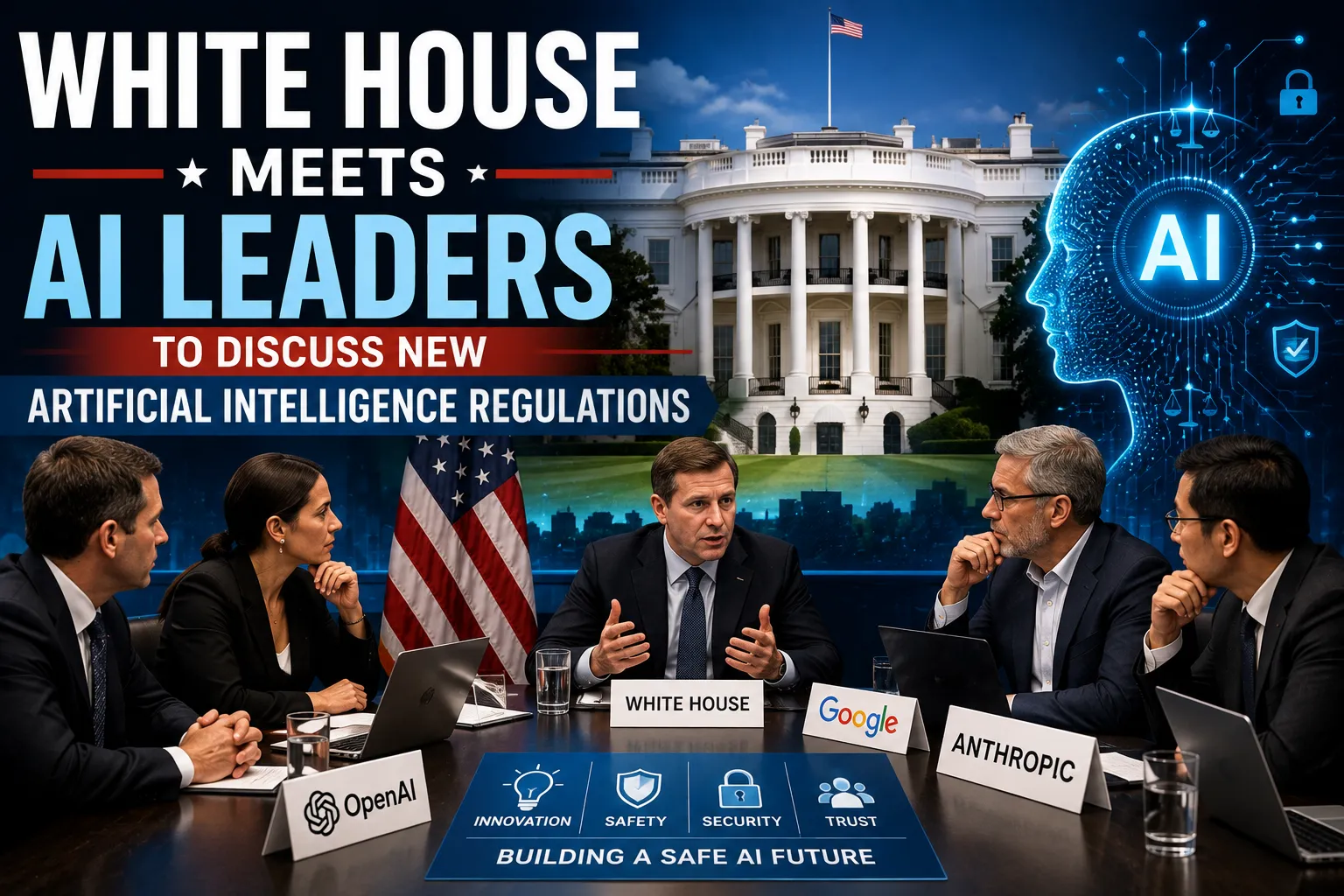
The White House has convened executives from several of the country’s leading artificial intelligence companies to discuss a new federal framework for overseeing advanced AI agents. The discussions reflect growing government interest in establishing guardrails for rapidly evolving AI technologies while preserving the United States’ competitive position in the global AI race.
Representatives from major AI developers, including OpenAI, Anthropic, and Google, met with administration officials to review proposals aimed at evaluating the cybersecurity and national security risks posed by increasingly capable AI models before they are released publicly.
A Shift Toward Structured AI Oversight
The meeting signals a notable evolution in U.S. AI policy. While recent federal initiatives have generally emphasized encouraging innovation and maintaining American leadership in artificial intelligence, officials are now exploring more structured oversight for the most advanced AI systems.
According to reports, the proposed framework would establish a voluntary review process for certain high-capability AI models, particularly those that could present cybersecurity or national security concerns if misused.
Rather than applying broadly to every AI application, the framework is expected to focus on frontier AI models capable of performing sophisticated technical tasks.
Why AI Regulation Is Becoming a Priority
Artificial intelligence is now being integrated into industries ranging from healthcare and finance to education, manufacturing, and government services.
As AI capabilities expand, policymakers are increasingly examining issues such as:
- Cybersecurity risks
- Critical infrastructure protection
- National security
- Model transparency
- Responsible deployment
- Public trust
- International competitiveness
Government officials argue that regulatory discussions should keep pace with technological progress without unnecessarily slowing innovation.
Industry Leaders Participate in Policy Discussions
The White House discussions brought together several of the most influential companies developing advanced AI systems.
These organizations have become central to conversations surrounding:
- Large language models
- AI assistants
- Enterprise AI
- Scientific research
- Software development
- National security applications
Technology companies have generally expressed support for clear policy guidance while emphasizing the importance of preserving America’s ability to innovate and compete globally.
Closed Models Versus Open Models
One of the most closely watched issues involves how different categories of AI models should be regulated.
Current discussions reportedly distinguish between:
Closed Models
These systems are developed and controlled by their creators, with underlying model weights and code remaining proprietary.
Examples include many commercial frontier AI models.
Open-Weight Models
These models make their weights publicly available, allowing developers and researchers to download, modify, and build upon them.
Reports indicate the proposed framework initially focuses on reviewing certain proprietary models rather than open-weight systems, although officials have suggested this approach could evolve as technology advances.
Cybersecurity Takes Center Stage
One of the primary motivations behind the new framework is cybersecurity.
Officials are examining how highly capable AI models could potentially:
- Discover software vulnerabilities
- Assist defensive cyber operations
- Accelerate code generation
- Support infrastructure management
- Improve security analysis
At the same time, policymakers are considering safeguards to reduce the risk of advanced systems being misused by malicious actors.
Balancing Innovation and Safety
The administration has repeatedly emphasized that any regulatory framework should avoid unnecessarily restricting AI innovation.
Recent White House policy documents highlight goals including:
- Accelerating responsible AI adoption
- Maintaining U.S. technological leadership
- Supporting cybersecurity
- Strengthening national security
- Encouraging private-sector innovation
Officials describe the proposed oversight as part of a broader strategy to balance innovation with responsible deployment.
Global Competition Shapes AI Policy
The discussions are also influenced by growing international competition in artificial intelligence.
Rapid advances by overseas AI developers have increased pressure on governments to strengthen domestic AI capabilities while protecting sensitive technologies and maintaining economic competitiveness.
Industry experts note that AI policy increasingly intersects with:
- Semiconductor development
- Cloud computing
- Export controls
- Scientific research
- Defense technology
These issues have elevated AI from a technology topic to a broader strategic policy priority.
Industry Response
Technology companies have largely welcomed ongoing dialogue with policymakers while seeking clarity on how future oversight may affect AI development and deployment.
Many companies favor:
- Predictable regulatory guidance
- Risk-based oversight
- Collaboration with government
- Clear technical standards
- International coordination
Some observers, however, have called for greater transparency regarding how review processes will operate and which AI systems may ultimately fall under federal oversight.
What Comes Next?
Although the discussions represent an important step, many details of the proposed framework remain under development.
Questions still being debated include:
- Which AI models qualify for review?
- Whether participation will remain voluntary
- How cybersecurity risks will be measured
- What role independent testing will play
- How future open-weight models may be addressed
Additional policy guidance is expected as discussions continue between government agencies and industry leaders.
Why This Matters
Artificial intelligence is becoming foundational to economic growth, scientific discovery, healthcare, education, and national security.
The White House discussions demonstrate that policymakers are seeking a governance model that both supports innovation and addresses emerging risks associated with increasingly powerful AI systems.
As governments worldwide develop their own approaches to AI oversight, decisions made in the United States are likely to influence international standards, investment strategies, and the future direction of AI development.
Key Takeaways
-
The White House met with executives from leading AI companies to discuss a new AI oversight framework.
-
The proposed approach focuses on evaluating certain advanced AI models for cybersecurity and national security risks before public release.
-
Officials aim to balance responsible oversight with continued AI innovation and global competitiveness.
-
Current discussions distinguish between proprietary (closed) AI models and open-weight models, with the initial framework reportedly emphasizing the former.
-
The outcome of these talks could shape future U.S. AI policy and influence international approaches to AI governance.