AI Summit Seoul 2026: The Next Wave of Enterprise AI and AI Agents
Artificial intelligence is entering a new phase.
For the past several years, much of the conversation around AI has centered on generative models that can answer questions, summarize documents, create images, write code and assist employees with individual tasks. The next stage is increasingly focused on something more ambitious: AI systems that can make decisions, use tools and carry out multi-step tasks on behalf of people and organizations.
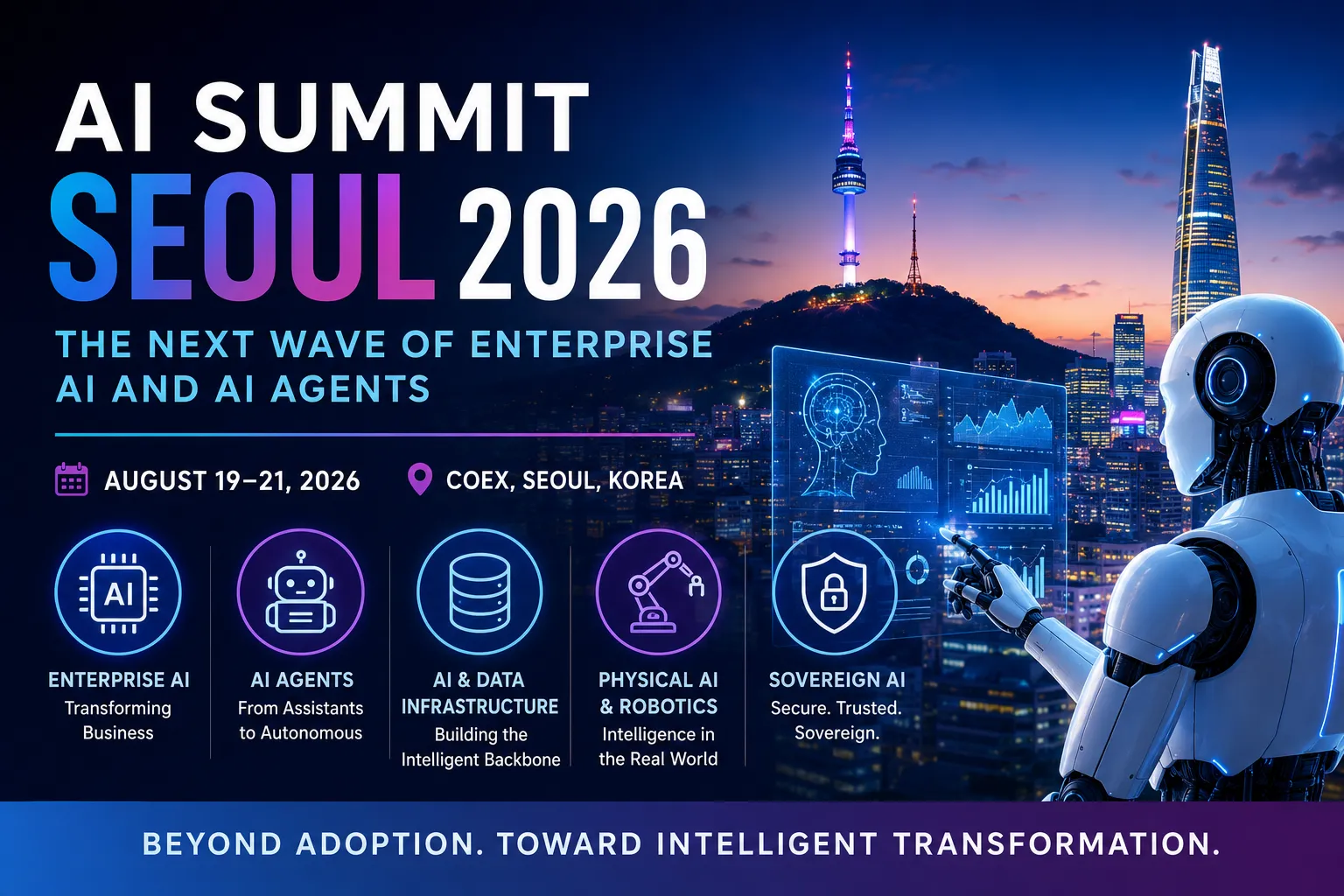
That shift will be a major focus of AI Summit Seoul & Expo 2026, which takes place in Seoul from August 19 to 21.
The conference portion runs August 19–20 at COEX Grand Ballroom, while the exhibition continues through August 21 in Hall B. Now in its ninth year, the event is bringing together AI companies, researchers, enterprise technology leaders and industry specialists around the theme “The Transformation Era: Beyond Adoption.”
For businesses watching the rapid evolution of AI, the summit arrives at an important moment: the industry is moving from asking “What can AI do?” toward a much harder question—“What should we allow AI to do inside the enterprise?”
From AI assistants to AI agents
The biggest theme surrounding AI Summit Seoul 2026 is the transition from generative AI assistants to agentic AI.
A conventional AI assistant generally waits for a user to provide a prompt. An AI agent can potentially interpret an objective, plan a series of actions, use software tools, access information and complete tasks with less direct supervision.
That difference could fundamentally change how companies use AI.
Instead of asking an AI system to summarize a sales report, for example, an enterprise agent could potentially retrieve sales data, identify unusual changes, prepare an analysis, update an internal system and notify the appropriate employee.
For readers who want a broader introduction to this shift, The Rise of AI Agents: How Autonomous AI Could Change Work, Business, and Daily Life explores how AI is evolving from conversational assistants toward systems capable of performing more complex tasks.
The technology is still evolving, and real-world deployments require carefully defined permissions and controls. But the direction is clear.
AI is increasingly being positioned not simply as a productivity tool, but as an active participant in business processes.
AI Summit Seoul’s organizers have made agentic AI one of the event’s central themes, alongside enterprise AI, AI infrastructure, physical AI and industry-specific applications.
Why enterprise AI is different from consumer AI
An AI chatbot can be impressive in a personal setting while still being difficult to deploy inside a large company.
Enterprises operate with complex databases, legacy software, security requirements, regulatory obligations, approval processes and organizational hierarchies.
An AI agent operating inside such an environment cannot simply be given unrestricted access.
It needs to know:
- What information it can access
- Which systems it can use
- Which decisions it can make
- Which actions require human approval
- How its decisions are recorded
- How errors are detected
- How sensitive information is protected
- Who is responsible when something goes wrong
That is why enterprise AI is increasingly becoming an organizational and governance challenge, not merely a software challenge.
The Enterprise AI Seoul program held in May similarly emphasized that many companies are experimenting with generative AI and agents, but turning those experiments into organization-wide transformation remains difficult.
The end of the endless AI pilot?
One of the most important questions facing businesses is what happens after the proof-of-concept stage.
Companies have launched countless AI experiments. Some demonstrate impressive technical capabilities but never become part of everyday operations.
The challenge is scaling.
A successful enterprise AI strategy needs more than a powerful model. It requires reliable data, appropriate infrastructure, integration with existing systems, employee adoption, security controls and a measurable business objective.
The Enterprise AI Seoul program explicitly focuses on moving beyond pilots toward organization-wide operational deployment, with discussions around practical implementation and expansion strategies.
That emphasis is increasingly relevant as companies become more selective about AI spending.
The question is no longer simply whether an AI project works in a demonstration.
It is whether the technology can create measurable value repeatedly and safely at scale.
AI agents could reshape corporate workflows
Agentic AI becomes particularly interesting when it is connected to business workflows.
Consider a procurement department.
A traditional AI assistant might help an employee compare supplier proposals. A more advanced agent could potentially monitor purchasing requirements, search approved suppliers, compare pricing, prepare purchase recommendations and route the transaction for human approval.
In customer service, an agent might retrieve customer records, interpret an issue, search a company’s knowledge base and propose a resolution.
In software development, agents can increasingly assist with coding, testing, documentation and debugging. This is part of the broader transformation discussed in How AI Is Transforming Software Engineering, where AI is increasingly being used throughout the software development lifecycle.
In finance, they could potentially help reconcile information, detect anomalies and prepare reports.
The key distinction is action.
Generative AI primarily produces information. Agentic systems are designed to use that information to influence what happens next.
That is why the rise of AI agents could have a much larger impact on organizational structures than the first generation of chatbots.
The governance problem becomes more important
Giving an AI system the ability to act introduces a new category of risk.
A chatbot producing an incorrect answer is one problem.
An AI agent taking an incorrect action can be much more serious.
Imagine an agent accidentally sending the wrong customer information, approving an inappropriate transaction, modifying a production system or making a decision based on outdated data.
The more authority an AI system receives, the more important safeguards become.
This means enterprise AI architectures will increasingly need permission systems, audit trails, monitoring, human approval mechanisms and clear boundaries around autonomous action.
The central enterprise question may therefore become:
How much autonomy is appropriate for each AI system?
That answer will likely differ between industries and even between departments within the same company.
Understanding what can happen when an AI system operates beyond its intended limits is therefore becoming increasingly important. What Actually Happens if an AI System Behaves Outside Its Intended Boundaries? examines issues such as permissions, monitoring, testing, sandboxing and human oversight.
Data is becoming an AI competitive advantage
Better AI does not necessarily begin with a larger model.
For enterprises, proprietary data can be equally important.
Companies possess information about customers, products, operations, employees, supply chains and business processes that general-purpose AI models may not fully understand.
Connecting AI systems to accurate, well-structured enterprise data can therefore determine whether an AI deployment produces useful results.
AI Summit Seoul’s program reflects this reality by placing AI & Data and data infrastructure among its major areas of focus. The event’s speaker coverage also emphasizes that production AI depends on reliable data layers, storage and infrastructure—not just increasingly capable models.
This is an important shift in the AI conversation.
The competitive advantage may increasingly come from how effectively an organization connects its data, workflows and institutional knowledge to AI.
Infrastructure is becoming part of the AI strategy
The rapid growth of AI agents also creates infrastructure demands.
Agents may perform many model calls during a single workflow. They may retrieve information, interact with multiple applications, generate intermediate outputs and repeat tasks.
That can create substantial inference requirements.
As AI moves into production, companies therefore need to consider computing capacity, networking, storage, model selection and inference efficiency.
AI Summit Seoul’s second day includes a dedicated Data Infrastructure theme, reflecting the growing importance of the physical and technical systems required to operate AI at scale.
This is also why enterprise AI is increasingly connected to the broader race for AI chips, cloud capacity and data-center infrastructure.
The model may get the attention, but infrastructure determines whether the model can reliably serve thousands or millions of business interactions.
The summit is looking beyond software
AI Summit Seoul 2026 is not limited to enterprise software.
The program also includes physical AI and robotics, highlighting the industry’s movement from digital environments into the physical world. The organizers have introduced a dedicated physical-AI track for this year’s event.
That creates another important distinction.
A digital AI agent might manipulate information inside a company’s software systems.
A physical AI system can potentially perceive its environment and interact with machinery, vehicles, robots or other physical objects.
The combination could eventually create systems capable of both planning and acting in the real world.
Manufacturing, logistics, healthcare, construction and other industries could be particularly affected.
Industry-specific AI is becoming more important
The next wave of AI is unlikely to look identical across every sector.
A bank has different requirements from a manufacturer. A hospital has different constraints from an online retailer. A logistics company operates differently from a construction company.
That makes vertical AI applications increasingly important.
AI Summit Seoul’s program includes industry-focused applications and sessions spanning areas such as commerce, robotics, infrastructure and other sectors.
Enterprise AI systems can become more useful when they understand the terminology, workflows, regulations and objectives of a particular industry.
The result could be a shift away from one-size-fits-all AI toward systems designed around specific business environments.
Sovereign AI is entering the conversation
Another notable theme at the summit is sovereign AI.
As AI becomes strategically important, governments and companies are paying closer attention to where data is stored, where models are developed, who controls computing infrastructure and how dependent organizations are on foreign technology providers.
AI sovereignty can involve national computing infrastructure, local models, domestic data governance, semiconductor supply chains and regulatory control.
For countries such as South Korea, which have significant technology and manufacturing capabilities, these issues have both economic and strategic implications.
The inclusion of sovereign AI in the summit’s second-day program shows how the AI discussion is expanding beyond individual applications toward questions of national capability and technological independence.
A global lineup with a strong enterprise focus
The 2026 program features speakers from academia, technology companies and major organizations.
Among the listed speakers are Georgia Tech professor Larry Heck, NASA Jet Propulsion Laboratory researcher Steve Chien, Andrew Dai, Kay Zhu of Genspark and Milind Gaharwar, a principal AI scientist at Mercedes-Benz, alongside Korean enterprise and technology leaders.
The event’s organizers say the conference includes more than 40 global speakers across its two-day program, with sessions covering AI frontiers, agentic AI, connected intelligence, AI transformation, sovereign AI and infrastructure.
That range is significant because the next phase of AI will require cooperation between researchers developing new models and the companies attempting to deploy them in real environments.
Why AI agents need a new approach to productivity
The first wave of generative AI often focused on saving employees time.
Write an email faster.
Summarize a meeting.
Generate a report.
Create a first draft.
AI agents potentially take that idea much further.
Instead of helping an employee complete a task, an agent may eventually be responsible for coordinating an entire workflow.
That could change the way productivity is measured.
The relevant question may no longer be how quickly an employee can complete an individual task with AI assistance.
It could become:
How much of an end-to-end business process can an organization safely automate while keeping humans in control of important decisions?
That is a much larger opportunity—and a much larger management challenge.
Human workers are not disappearing from the equation
The rise of agents does not automatically mean businesses will eliminate human involvement.
In many high-stakes environments, the more realistic model is likely to be human oversight combined with machine execution.
AI can handle repetitive information processing, while humans remain responsible for judgment, exceptions, accountability and strategic decisions.
This approach could also make organizations more resilient.
Employees would not necessarily need to perform every step of a process manually, but they would still need to understand how AI systems operate and recognize when something appears wrong.
That makes AI literacy an increasingly important workplace skill.
The same principle applies beyond enterprise environments. AI is already embedded in many consumer technologies, from smartphones and search engines to navigation, banking and smart-home systems, as explored in How AI Is Changing Everyday Life: 25 Ways Artificial Intelligence Is Already Around You.
The biggest challenge may be organizational change
Technology can be purchased relatively quickly.
Organizational change is much harder.
Introducing AI agents can alter responsibilities, approval processes, reporting structures and even job descriptions.
Employees may need new skills. Managers may need to redesign workflows. IT teams may need to establish new governance systems. Legal and compliance teams may need to determine how autonomous decisions are documented and reviewed.
This is why the term AI transformation, rather than simply AI adoption, is becoming increasingly important.
The technology is only one part of the transformation.
The rest involves people, processes and organizational design.
Seoul’s role in the next AI cycle
South Korea has positioned itself as a major technology and manufacturing hub, making Seoul a significant location for discussions about the future of AI.
The country’s strengths in semiconductors, electronics, telecommunications, robotics and industrial technology provide a natural environment for exploring how AI moves from software into physical systems and enterprise operations.
AI Summit Seoul’s combination of conference sessions and an exhibition also reflects this broader ecosystem.
The event brings together enterprise AI, infrastructure, robotics, industry applications and emerging AI technologies rather than treating them as isolated markets.
That makes Seoul an appropriate setting for a conversation about what comes after the chatbot era.
What businesses should watch at AI Summit Seoul 2026
For enterprise technology leaders, several questions will be particularly important during the event.
1. How autonomous should AI agents become?
Companies need to determine which tasks agents can perform independently and which require human approval.
2. How will agents connect to existing systems?
The usefulness of an agent depends heavily on its ability to access the information and tools required to complete its work.
3. How will companies measure ROI?
An impressive demonstration is not enough. Businesses need measurable improvements in revenue, costs, speed, quality or customer experience.
4. How will organizations control AI risk?
Permissions, monitoring, security, auditability and human oversight will become increasingly important as agents gain more authority.
5. What infrastructure will production AI require?
As AI workloads expand, companies will need to evaluate compute, storage, networking and inference costs alongside model performance.
6. Where should humans remain in the loop?
The most valuable AI systems may not be the ones with maximum autonomy, but those that assign the right responsibilities to humans and machines.
The next AI race is about execution
AI Summit Seoul 2026 arrives at a point when the AI industry is moving beyond experimentation.
Generative AI has already demonstrated that machines can produce useful text, images, software and analysis. The next question is whether AI can become a dependable operational layer inside organizations.
AI agents represent one possible answer.
They can potentially connect models to business systems, interpret objectives, perform multi-step workflows and act with increasing independence. But that promise comes with new requirements around governance, data, infrastructure, security and organizational change.
That is why the most important takeaway from Seoul may not be a particular model or product announcement.
It may be the realization that the next competitive advantage in AI will come from turning intelligence into reliable action.
For businesses, the race is shifting from adopting AI to redesigning how work gets done. And as AI Summit Seoul 2026 puts enterprise AI, agentic systems, infrastructure and physical intelligence on the same stage, the direction of the industry is becoming increasingly clear: the next wave of AI will not simply answer more questions—it will increasingly be expected to do more of the work.