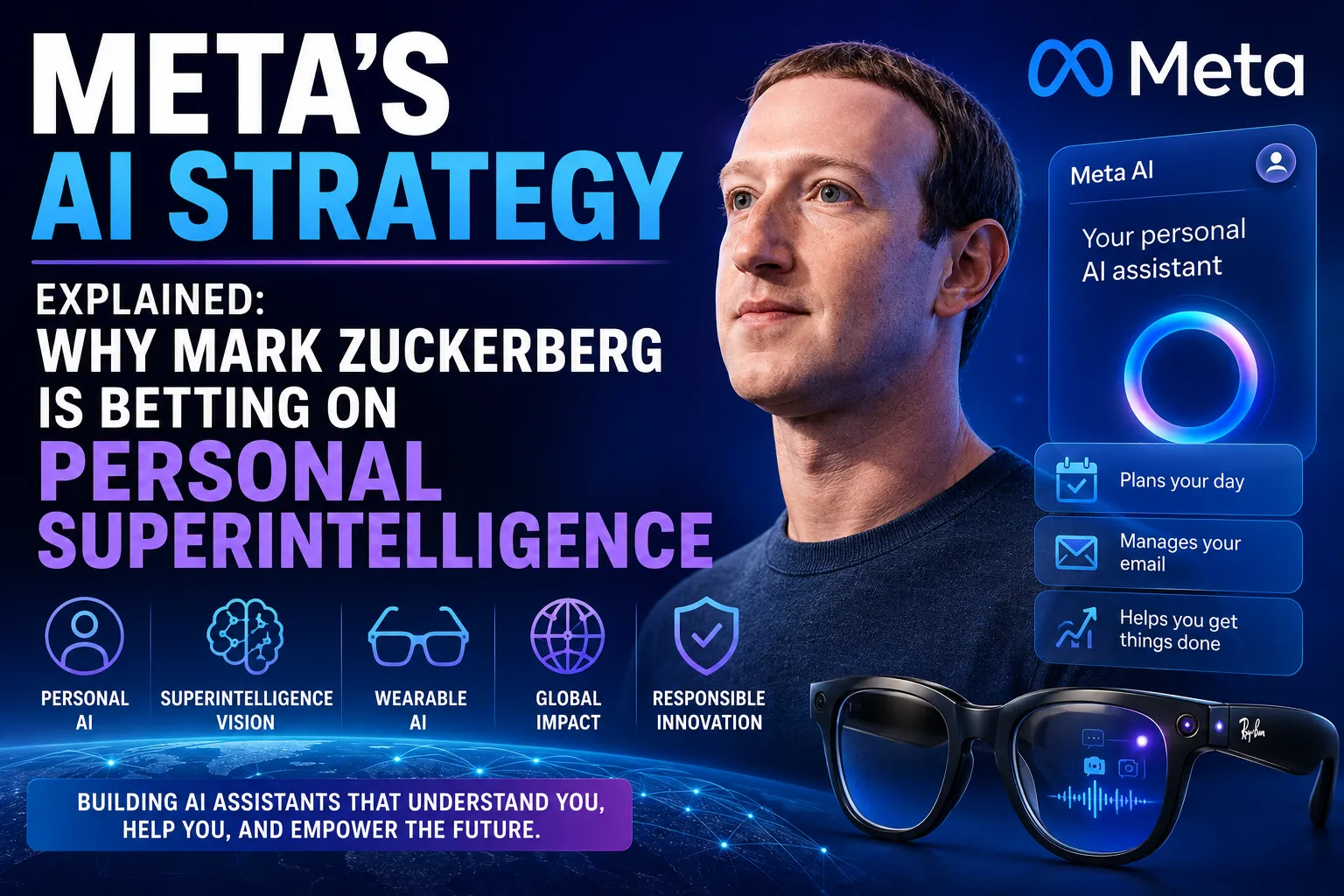
Meta’s AI Strategy Explained: Why Mark Zuckerberg Is Betting on Personal Superintelligence
Meta is no longer treating artificial intelligence as simply another feature to add to Facebook, Instagram or WhatsApp.
The company is positioning AI as the foundation of its next major computing platform—and Mark Zuckerberg is making an unusually ambitious bet on what that platform will look like.
His vision is centered on personal superintelligence: highly capable AI systems that are personalized to individual users, understand their context, operate across devices and eventually take meaningful actions on their behalf.
Meta has been moving toward this idea for years, but the strategy has become much more concrete. The company has built a dedicated Meta Superintelligence Labs organization, developed the Muse family of AI models, expanded its AI infrastructure and pushed AI into products such as its smart glasses. In July 2026, Meta said its AI could already plan tasks, connect to email and calendars, create presentations and execute tasks on a user’s behalf. (About Facebook)
Zuckerberg’s latest argument is that the ultimate AI opportunity isn’t simply creating one extremely powerful system controlled by a handful of institutions.
It is putting highly capable AI directly in the hands of individuals.
That distinction explains much of Meta’s current AI strategy.
What Does Meta Mean by “Personal Superintelligence”?
The phrase sounds futuristic, but the basic idea is relatively straightforward.
Instead of interacting with a general-purpose chatbot that knows little about you, imagine an AI assistant that understands:
- Your preferences
- Your schedule
- Your interests
- Your communication habits
- Your goals
- Your work
- Your frequently used apps
- Your devices
- Your long-term context
It could then use that information to help with tasks continuously rather than waiting for you to type a prompt.
Meta has already been moving in this direction.
The company’s AI app was designed to become more personalized, while Meta has introduced memory features that allow its assistant to remember certain information shared in individual conversations. (About Facebook)
The next step is much more ambitious.
Rather than simply answering questions, the AI becomes an agent that can plan and execute tasks.
Meta’s Muse Spark-powered AI, for example, can plan, interact with connected applications and follow tasks through from beginning to end. (About Facebook)
That’s an important shift.
The chatbot answers.
The agent acts.
And Meta wants that agent to become increasingly personal.
Why Zuckerberg Is Betting on Personal AI
There are several strategic reasons behind the company’s approach.
1. Meta Already Has Billions of Potential AI Users
Meta’s biggest advantage isn’t simply its AI research.
It’s distribution.
The company operates a huge ecosystem spanning:
- Messenger
- Threads
- Meta AI
- AI glasses
That gives Meta something many AI startups lack: existing relationships with enormous numbers of consumers.
Meta introduced its standalone AI app in 2025 while also integrating AI across its existing services. The company described the app as a more personal assistant capable of remembering context and connecting with experiences across its platforms. (About Facebook)
If Meta succeeds in making AI genuinely useful, it doesn’t need to convince consumers to discover an entirely new technology ecosystem.
It can bring AI to places they already use.
2. Personalization Could Become AI’s Biggest Competitive Advantage
The AI industry has largely competed around model intelligence.
Companies have asked:
Which model reasons better?
Which model writes better code?
Which model performs better on benchmarks?
But as models become increasingly capable, another question becomes more important:
Which AI understands the individual user best?
That’s where Meta has an unusual advantage.
Its platforms already process enormous amounts of information about how people interact with digital content.
Meta has spent years building recommendation systems that personalize feeds, advertisements and content.
Its AI strategy effectively extends that personalization philosophy into an assistant.
Instead of:
“Here is a good recommendation for someone like you.”
the goal becomes:
“I understand what you are trying to accomplish, and I can help you accomplish it.”
That is a much larger product opportunity.
3. Meta Wants AI to Become a New Computing Interface
The smartphone transformed computing by making applications portable.
The next transformation could be making AI the primary interface through which people interact with computing.
Instead of opening an application, navigating menus and manually completing tasks, users could increasingly tell an AI what they want.
For example:
“Find a good restaurant for Friday and put the reservation on my calendar.”
Or:
“Turn these notes into a presentation.”
Or:
“Help me plan a three-day trip based on my preferences.”
The AI becomes the layer connecting different services.
Meta’s recent AI developments show that the company is moving in precisely this direction, with its assistant gaining capabilities for planning, tool use and task execution. (About Facebook)
Meta’s AI Strategy Goes Beyond Chatbots
One of the clearest signs of Meta’s ambitions is the evolution of its AI models.
In April 2026, Meta introduced Muse Spark, describing it as a multimodal reasoning model designed around tool use and multi-agent orchestration. The company presented it as the first step in a broader scaling strategy toward personal superintelligence. (Meta AI)
That language matters.
A conventional chatbot primarily produces responses.
An agentic AI system can potentially:
- Understand a goal
- Break it into smaller tasks
- Decide which tools it needs
- Perform actions
- Check results
- Adjust its approach
- Complete the objective
That makes AI much more useful for real-world work.
The Importance of AI Agents
AI agents could eventually become one of the most important parts of Meta’s strategy.
Imagine an assistant that doesn’t simply tell you how to organize your schedule but actually helps manage it.
Or one that doesn’t just explain how to create a presentation but creates the presentation, organizes the slides and prepares the supporting material.
Meta’s July 2026 announcement suggests that this transition is already underway. The company said Meta AI can connect with email and calendar applications, create slides and carry out tasks for users. (About Facebook)
This is the beginning of a broader shift from generative AI to action-oriented AI.
Meta’s AI Glasses Are Strategically Important
The company’s smart glasses could be one of the most important pieces of the personal superintelligence strategy.
A smartphone requires users to look down at a screen.
Glasses can potentially provide AI assistance while people are:
- Walking
- Working
- Traveling
- Shopping
- Exercising
- Interacting with other people
Meta has increasingly connected its AI ambitions to wearable computing.
The company has described its AI glasses as tools that can help people work, learn and live more independently. It has also expanded programs demonstrating applications in accessibility, education, workforce safety and other areas. (About Facebook)
This suggests that Meta doesn’t view AI glasses simply as another hardware product.
They could become an always-available interface for personal AI.
Why Wearable AI Could Change the Equation
Consider the difference between these two experiences.
Smartphone AI
You:
- Take out your phone
- Unlock it
- Open an application
- Type or speak
- Read the response
Wearable AI
You could potentially:
- Ask naturally
- Receive an answer through audio or another interface
- Continue what you’re doing
That reduction in friction could fundamentally change how frequently people use AI.
The more convenient an assistant becomes, the more likely people are to use it throughout the day.
And the more they use it, the more useful personalization can become.
That creates a powerful feedback loop.
The Personalization Flywheel
Meta’s strategy can be understood as a cycle:
More usage → more context → better personalization → greater usefulness → more usage
If an AI assistant knows a user’s preferences, routines and previous interactions, it can potentially provide better assistance.
Better assistance encourages more usage.
More usage provides more context.
That makes the assistant increasingly valuable.
This is one reason personal AI could become much more strategically important than a simple chatbot.
Why Open AI Models Matter to Meta
Meta has historically taken a different approach from companies that keep their most powerful AI models entirely closed.
The company’s Llama strategy emphasized open-weight models and broad developer access.
Zuckerberg has continued to argue that AI should be widely distributed rather than controlled by a small number of companies or governments.
In his latest AI manifesto, The Future is for Everyone, he again argued for broad access to powerful AI and made the case for open-weight development. (Reuters)
This isn’t only an ideological position.
It can also be a business strategy.
Why Open AI Could Benefit Meta
A large ecosystem of developers building around Meta’s models can produce several advantages.
Developers can:
- Create applications
- Build specialized tools
- Experiment with new use cases
- Improve model adoption
- Expand the ecosystem
- Create demand for AI infrastructure
The more widely Meta’s AI technology is adopted, the more likely it is to become part of the broader AI ecosystem.
That can make Meta less dependent on consumers interacting exclusively with AI through Meta’s own applications.
The Open-Source Argument Has Strategic Implications
The AI industry is increasingly divided between different approaches to model distribution.
Some companies emphasize proprietary models.
Others support open or open-weight approaches.
Meta’s strategy is strongly tied to the second camp.
Zuckerberg’s argument is that concentrating advanced AI in a small number of organizations could give those organizations excessive control.
He has argued instead that individuals and businesses should have access to increasingly powerful AI systems. (Reuters)
Critics, however, argue that open access to highly capable AI can also make powerful technology easier to misuse.
That tension isn’t going away.
The Massive Infrastructure Bet Behind Meta AI
Personal superintelligence requires enormous computing resources.
Training advanced models requires large amounts of computing power.
Running those models for billions of users requires even more.
Meta has therefore been investing heavily in AI infrastructure.
The company says it is building AI-optimized data centers and expanding its computing capabilities. It has also partnered with Arm to develop a new class of data-center CPUs designed to support large-scale AI workloads. (About Facebook)
This infrastructure is critical to the strategy.
The AI assistant is the visible product.
The data centers are the machinery underneath it.
Meta’s AI Spending Shows How Big the Bet Is
The scale of Meta’s investment demonstrates that Zuckerberg isn’t treating AI as a side project.
Reuters reported that Meta’s 2026 capital-expenditure forecast had risen to $130 billion–$145 billion, with the spending driven heavily by AI infrastructure. The company also reported a significant decline in free cash flow during the second quarter as investment accelerated. (Reuters)
That creates a major financial question.
Meta has a highly profitable advertising business today.
But Zuckerberg is spending enormous sums to build infrastructure for what he believes could become an even larger technological platform.
The company is effectively making a long-term bet that AI will justify the investment.
AI Could Also Strengthen Meta’s Existing Advertising Business
Personal AI doesn’t necessarily have to replace Meta’s existing business model.
It could make that business stronger.
Meta already uses AI extensively for:
- Content recommendations
- Advertising
- Ranking
- Personalization
- Image and video generation
- Business tools
The company has reported improvements in content recommendation and engagement driven by AI systems. (About Facebook)
More capable AI could therefore improve Meta’s existing products while creating entirely new businesses.
That gives Meta an advantage over startups that need AI itself to become profitable.
AI Agents Could Create New Business Models
Personal AI could eventually enable Meta to monetize capabilities beyond advertising.
Potential areas include:
- Premium AI subscriptions
- Business AI agents
- Developer services
- AI-powered commerce
- Enterprise tools
- Advanced computing access
- AI hardware
- Agent-based services
The precise business model remains uncertain.
But Meta’s enormous user base provides multiple potential paths to monetization.
Zuckerberg’s AI Vision Extends to Entrepreneurship
One of the more interesting parts of Zuckerberg’s vision is his belief that AI could make small teams dramatically more powerful.
If AI agents can handle tasks traditionally requiring specialized employees, a small company could potentially accomplish much more with fewer people.
That could reduce barriers to entrepreneurship.
A small team might eventually use AI to assist with:
- Marketing
- Software development
- Customer support
- Research
- Design
- Accounting
- Sales
- Administration
Zuckerberg has argued that this could result in smaller companies capable of producing substantial economic value rather than simply eliminating jobs. (Business Insider)
Whether that prediction proves correct remains one of the biggest unanswered questions surrounding advanced AI.
The Jobs Question Is Still Unresolved
Meta’s optimistic vision contrasts with concerns about automation.
If increasingly capable AI can perform more tasks, companies could potentially require fewer workers for some roles.
At the same time, new businesses and occupations could emerge.
Historically, technological change has often done both.
The difficult question is how quickly AI will transform existing work compared with the rate at which new opportunities appear.
Zuckerberg believes AI will expand human capability and entrepreneurship.
Critics worry that the transition could produce significant disruption before those benefits are broadly distributed. (People.com)
The outcome will likely depend on more than AI capability itself.
Education, labor markets, regulation, business strategy and access to technology will all matter.
The Biggest Challenge: Trust
Personal superintelligence requires something ordinary chatbots don’t necessarily need to the same degree:
deep trust.
People may be willing to ask a chatbot a random question without giving it extensive personal information.
An AI assistant that manages parts of your life is different.
Users may expect it to understand:
- Personal schedules
- Relationships
- Work
- Financial decisions
- Preferences
- Communications
- Location
- Health-related information
That creates enormous privacy and security responsibilities.
Personalization Creates a Privacy Paradox
The more an AI knows about you, the more useful it can become.
But the more it knows, the greater the potential consequences if that information is:
- Misused
- Exposed
- Incorrectly interpreted
- Accessed by unauthorized parties
- Used in ways users did not expect
This creates a fundamental tension:
Personal AI needs context, but context creates risk.
Meta will therefore need to convince users that personalization is worth the privacy trade-offs.
AI Glasses Make Privacy Even More Complicated
Wearable AI introduces another layer of complexity.
A smartphone is usually clearly visible when someone is using it.
Smart glasses can potentially capture information while appearing to function like ordinary eyewear.
That raises questions about:
- Recording
- Consent
- Bystander privacy
- Data storage
- Audio collection
- Facial recognition
- Location information
Meta will need to balance convenience with strong safeguards as AI becomes more integrated into physical environments.
Meta’s AI Strategy Also Depends on Safety
The more autonomous AI becomes, the more important reliability becomes.
A system that generates an incorrect answer is one problem.
A system that takes an incorrect action is another.
Imagine an AI agent that:
- Sends the wrong email
- Books the wrong reservation
- Purchases something unnecessarily
- Deletes information
- Misinterprets an instruction
- Shares private information
As AI moves from generating content to performing actions, error management becomes increasingly important.
Meta’s own AI research organization has highlighted reliability, security and user protections as important considerations as it develops more capable personalized systems. (Meta AI)
The Geopolitical Dimension of Meta’s AI Strategy
Meta’s AI strategy isn’t taking place in a vacuum.
The company is also positioning AI development as part of a broader technological competition between the United States and China.
Zuckerberg has argued that U.S. restrictions should not unnecessarily prevent American companies from developing and distributing advanced AI, particularly as China competes aggressively in the field. (Reuters)
This adds another dimension to Meta’s strategy.
The company isn’t simply competing for consumers.
It is also competing for:
- Computing resources
- AI researchers
- Developers
- Infrastructure
- Global standards
- Government influence
- Technological leadership
Why Meta Wants to Shape AI Regulation
Meta has a significant interest in how governments regulate AI.
Strict rules can potentially increase costs and slow deployment.
But weak safeguards can create public backlash and increase the risks associated with advanced AI.
Zuckerberg has therefore argued for policies that encourage AI development while maintaining security measures. His recent manifesto called for changes to some U.S. restrictions while also advocating cooperation with government on AI security. (The Verge)
This is likely to remain a major political issue.
Meta’s Biggest Competitive Advantage May Be Distribution
When evaluating Meta’s AI strategy, it is easy to focus exclusively on its models.
But the company’s strongest asset may be something else.
Distribution.
Meta can potentially place AI in the hands of users through a network of products that already have enormous global reach.
That includes social platforms, messaging services and wearable devices.
A technically impressive AI model without distribution has to find users.
Meta already has the users.
But Distribution Doesn’t Guarantee AI Leadership
There is an important counterargument.
Users may not automatically choose Meta AI simply because it appears inside Meta’s products.
AI competition is increasingly based on:
- Intelligence
- Reliability
- Speed
- Personalization
- Ecosystem integration
- Privacy
- Cost
- Developer support
- User trust
If another company builds a significantly better assistant, consumers may use it regardless of where it is offered.
Meta therefore needs both distribution and competitive AI capability.
The Muse Strategy Is Part of That Race
Meta’s Muse models represent an effort to close the gap between its AI ambitions and the most advanced systems in the industry.
Muse Spark was introduced as the first model in a new family and as part of Meta’s broader scaling effort toward personal superintelligence. (Meta AI)
Meta has since continued developing the Muse family.
The company has described its newer models as increasingly capable across reasoning, multimodal interaction and agentic tasks.
That suggests Meta’s strategy isn’t simply to deploy an existing AI model across its products.
It is trying to build the underlying intelligence itself.
Why Zuckerberg Is Thinking Beyond the Chatbot Era
The strategic logic becomes clearer when the pieces are connected.
Meta is building:
AI models
↓
AI agents
↓
Personalized assistants
↓
AI-powered applications
↓
AI glasses and other hardware
↓
Massive computing infrastructure
↓
A new personal computing platform
This is much bigger than adding an AI chatbot to Instagram.
It is an attempt to redefine how people interact with technology.
What Could Personal Superintelligence Actually Look Like?
If Meta’s vision succeeds, the AI assistant of the future may not resemble today’s chatbot interface.
It could be:
- Always available
- Multimodal
- Voice-driven
- Personalized
- Context-aware
- Agentic
- Connected across devices
- Integrated with applications
- Able to remember long-term preferences
The user might not even think of it as “using an AI app.”
It could simply become part of the way they interact with technology.
The Biggest Question Is Who Controls the Assistant
This may ultimately be the most important issue.
If AI becomes the interface between people and the digital world, the company controlling that interface gains enormous influence.
An AI assistant could potentially determine:
- What information users see
- Which services they use
- Which products they discover
- Which recommendations they receive
- Which tasks get prioritized
- Which applications interact with one another
That gives the AI platform enormous strategic power.
Meta’s argument is that personal superintelligence should put more power in the hands of individuals.
Critics may ask whether an AI ecosystem built by one of the world’s largest technology companies actually decentralizes power—or simply creates a new form of platform dependence.
That debate is likely to become more important as AI agents become more capable.
Meta’s Bet Is Bigger Than AI
Mark Zuckerberg’s AI strategy is ultimately a bet about the next era of computing.
Meta isn’t simply trying to build a chatbot that answers questions.
It wants to build AI that knows you, helps you and eventually acts for you.
The company has the ingredients to pursue that vision: a massive consumer ecosystem, years of personalization expertise, growing AI research capabilities, dedicated AI hardware ambitions, enormous infrastructure investments and a willingness to spend heavily before the eventual payoff is clear. (About Facebook)
But the risks are equally substantial.
Meta must prove that its AI is reliable enough to trust, personal enough to be useful, private enough to feel safe and capable enough to compete with the industry’s strongest systems.
And it must convince users that giving an AI deeper access to their lives is worth the convenience that comes in return.
For Zuckerberg, the opportunity is enormous: turn AI from something people occasionally open into something that is continuously present in their lives.
If that happens, the winner of the AI race may not simply be the company with the smartest model.
It could be the company whose AI becomes the most useful—and most trusted—personal interface to the digital world.